What Is the Generative AI Leader Certification and What Does It Cover?
2026-06-24
TL;DR
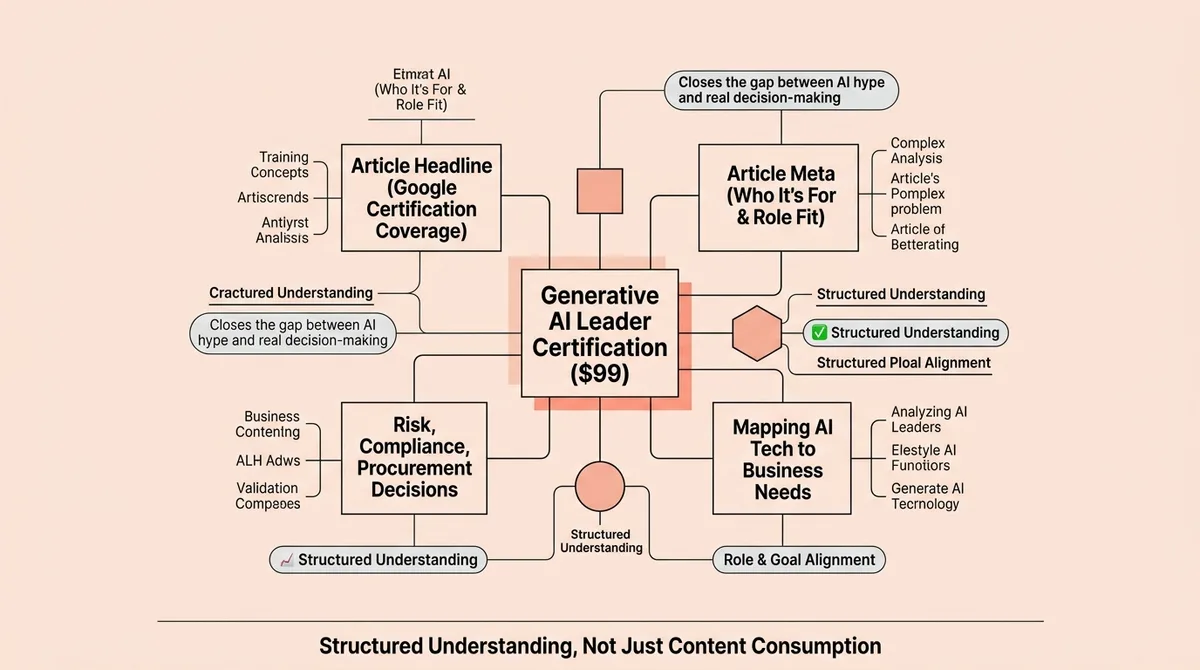
You are sitting in a leadership meeting where someone asks whether your team should adopt a specific AI tool. You have used ChatGPT. You have read the headlines. But you cannot map the technology to a business risk, a compliance question, or a procurement decision with any confidence.
Most professionals try to close that gap by consuming more content. More articles, more YouTube walkthroughs, more vendor demos. The gap stays open because consumption is not the same as structured understanding.
The Google Cloud Generative AI Leader certification gives business professionals a defined framework for evaluating, communicating, and applying generative AI concepts at a strategic level. It costs $99 [\[2\]](#ref-2), takes 90 minutes [\[2\]](#ref-2), and requires no prior technical background [\[2\]](#ref-2). CEOs, operations leads, and consultants who need a verifiable signal of AI literacy, not a coding credential, are the target audience.
* * *
What is the Google Generative AI Leader certification?
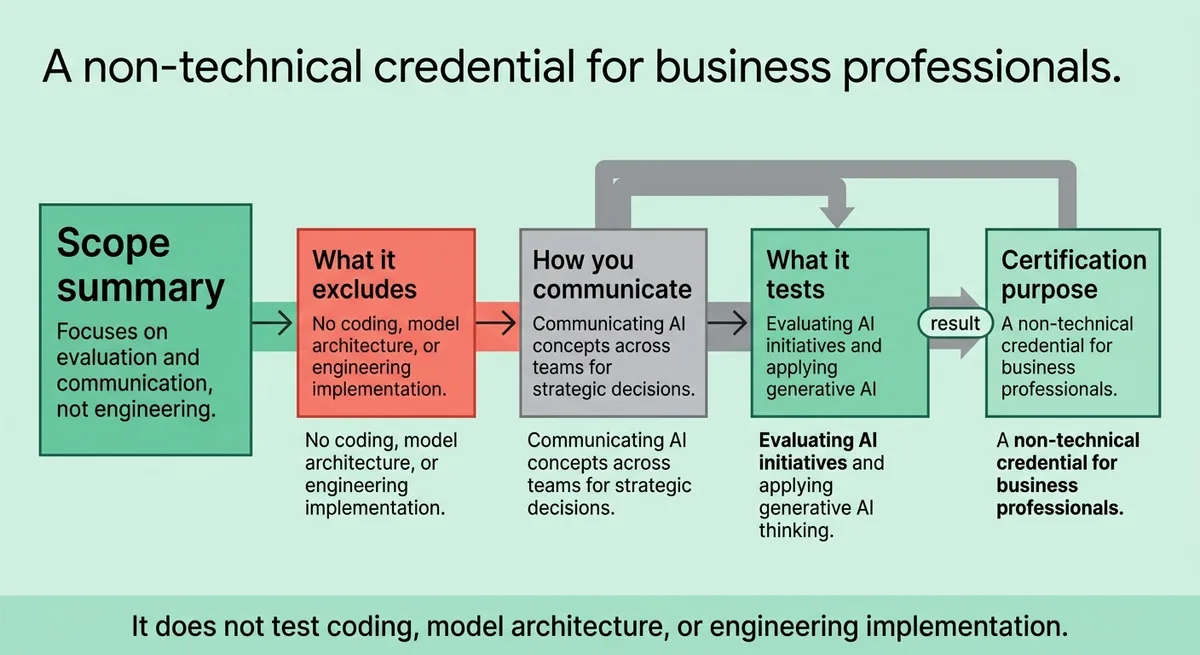
The Google Cloud Generative AI Leader certification is a non-technical credential for business professionals. It tests whether you can evaluate AI initiatives, communicate AI concepts across teams, and apply generative AI thinking to strategic decisions. It does not test coding, model architecture, or engineering implementation.
* * *
What the Certification Is and Who It Is Actually Built For
An operations manager opens her laptop on a Monday morning. Her CEO forwarded an article about AI agents. The subject line reads "Should we be doing this?" She has no framework to answer that question.
That is the exact professional this credential addresses.
The exam requires zero prerequisites [\[2\]](#ref-2). You do not need a computer science background. You do not need prior Google Cloud experience. The credential sits at the intersection of business strategy and AI literacy, not at the engineering layer.
The exam is available in four languages [\[2\]](#ref-2), which signals that Google designed it for a global business audience, not a narrow technical community. You can take it in two delivery modes [\[2\]](#ref-2): remote proctored or at a testing center. That flexibility reflects who the audience is, people running companies or functions, not people sitting in developer bootcamps.
Familiarity with AI tools is not the same as AI literacy.
Using ChatGPT to write emails does not prepare you to evaluate a vendor's AI claims, assess data privacy risk, or build an internal adoption roadmap. This credential tests the second category, not the first.
The certification fits a specific professional profile. If your role involves any of these activities, the credential maps directly to your responsibilities:
- Evaluating AI vendors or tools for your organization
- Communicating AI strategy to boards, investors, or clients
- Leading teams that use or implement AI systems
- Advising organizations on where AI creates or destroys value
If your goal is to build AI models, write prompts at scale, or deploy machine learning pipelines, this is not the right credential. It does not cover those topics.
Google's own learning path for this certification includes five structured activities [\[1\]](#ref-1), which span concept review, scenario practice, and assessment preparation. That structure tells you something. The credential is not a participation trophy. It expects you to learn a defined body of knowledge before sitting the exam.
* * *
What the Exam Actually Tests Across Its Four Topic Areas
The exam runs 50 to 60 multiple-choice questions [\[2\]](#ref-2) across four topic domains [\[2\]](#ref-2). A separate study community breakdown lists the domain weights at approximately 30%, 35%, 20%, and 15% [\[3\]](#ref-3). Knowing those weights changes how you allocate your preparation time.
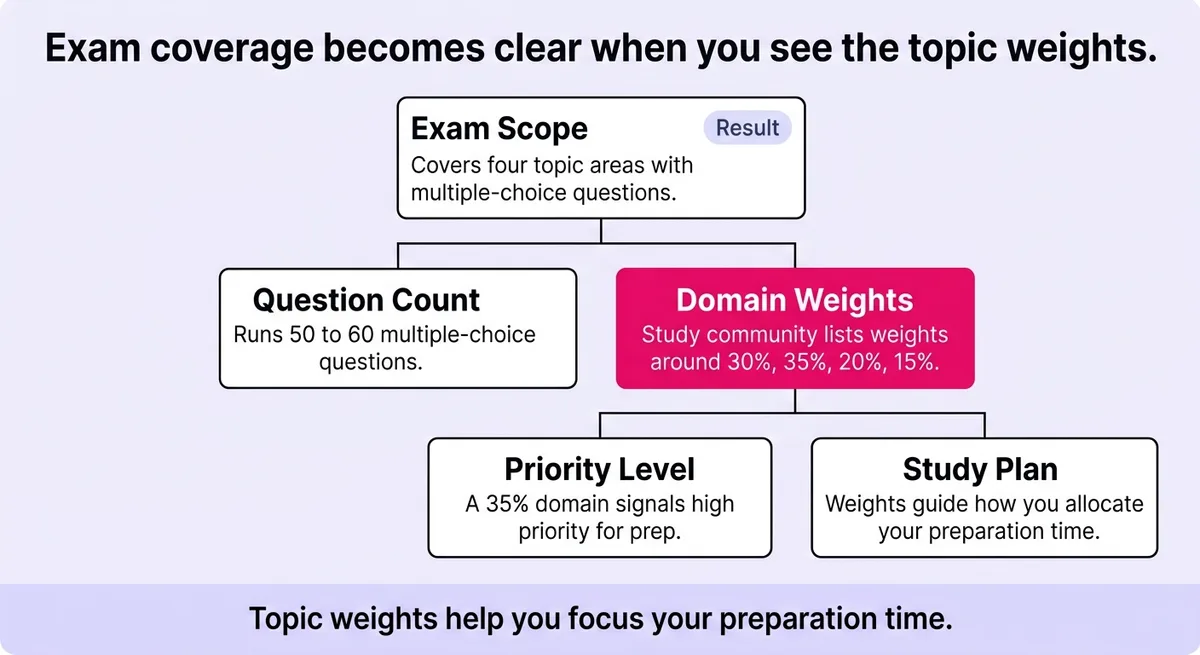
A practical breakdown of what each weight means for your study approach:
<table class="border-collapse w-full my-4 table-auto mx-4 max-w-4xl sm:mx-auto" style="min-width: 75px;"><colgroup><col style="min-width: 25px;"><col style="min-width: 25px;"><col style="min-width: 25px;"></colgroup><tbody><tr><th class="border border-border px-4 py-3 bg-muted font-semibold text-left" colspan="1" rowspan="1"><p>Domain Weight</p></th><th class="border border-border px-4 py-3 bg-muted font-semibold text-left" colspan="1" rowspan="1"><p>Priority Level</p></th><th class="border border-border px-4 py-3 bg-muted font-semibold text-left" colspan="1" rowspan="1"><p>What It Signals</p></th></tr><tr><td class="border border-border px-4 py-3" colspan="1" rowspan="1"><p>35%</p></td><td class="border border-border px-4 py-3" colspan="1" rowspan="1"><p>High</p></td><td class="border border-border px-4 py-3" colspan="1" rowspan="1"><p>This domain alone can pass or fail you</p></td></tr><tr><td class="border border-border px-4 py-3" colspan="1" rowspan="1"><p>30%</p></td><td class="border border-border px-4 py-3" colspan="1" rowspan="1"><p>High</p></td><td class="border border-border px-4 py-3" colspan="1" rowspan="1"><p>Combine with 35% domain; these two carry 65% of the exam</p></td></tr><tr><td class="border border-border px-4 py-3" colspan="1" rowspan="1"><p>20%</p></td><td class="border border-border px-4 py-3" colspan="1" rowspan="1"><p>Medium</p></td><td class="border border-border px-4 py-3" colspan="1" rowspan="1"><p>Enough to shift your score by one tier</p></td></tr><tr><td class="border border-border px-4 py-3" colspan="1" rowspan="1"><p>15%</p></td><td class="border border-border px-4 py-3" colspan="1" rowspan="1"><p>Low</p></td><td class="border border-border px-4 py-3" colspan="1" rowspan="1"><p>Study last; do not ignore it completely</p></td></tr></tbody></table>
The two heaviest domains carry 65% of your total score. If you spend equal time on all four areas, you are under-preparing for the sections that matter most and over-investing in areas that contribute least.
Google does not publish domain names publicly with the weights. That means you need the study community documentation [\[3\]](#ref-3) or a structured prep resource to map your knowledge gaps accurately. Going in blind costs you time and money.
The exam questions are multiple-choice [\[2\]](#ref-2). That format has an implication most candidates miss. Multiple-choice at the strategic level tests your ability to distinguish between a correct-sounding answer and a correct answer. Vendor marketing language and genuine AI strategy often look similar on paper. The exam exposes the difference.
Stop memorizing definitions. Start practicing decision scenarios where two answers both sound reasonable.
Reading about AI concepts gives you vocabulary. Working through scenario questions where you must choose between two plausible strategies builds the judgment the exam actually measures.
One implementation caveat worth knowing: some candidates with strong day-to-day AI tool experience report being surprised by questions that require structured business reasoning rather than product familiarity. Using AI tools at work does not map directly to the conceptual frameworks the exam tests. Prepare for the framework layer, not the tool layer.
* * *
You Probably Think You Can Wing This Without a Study Plan , Here Is Why That Costs You
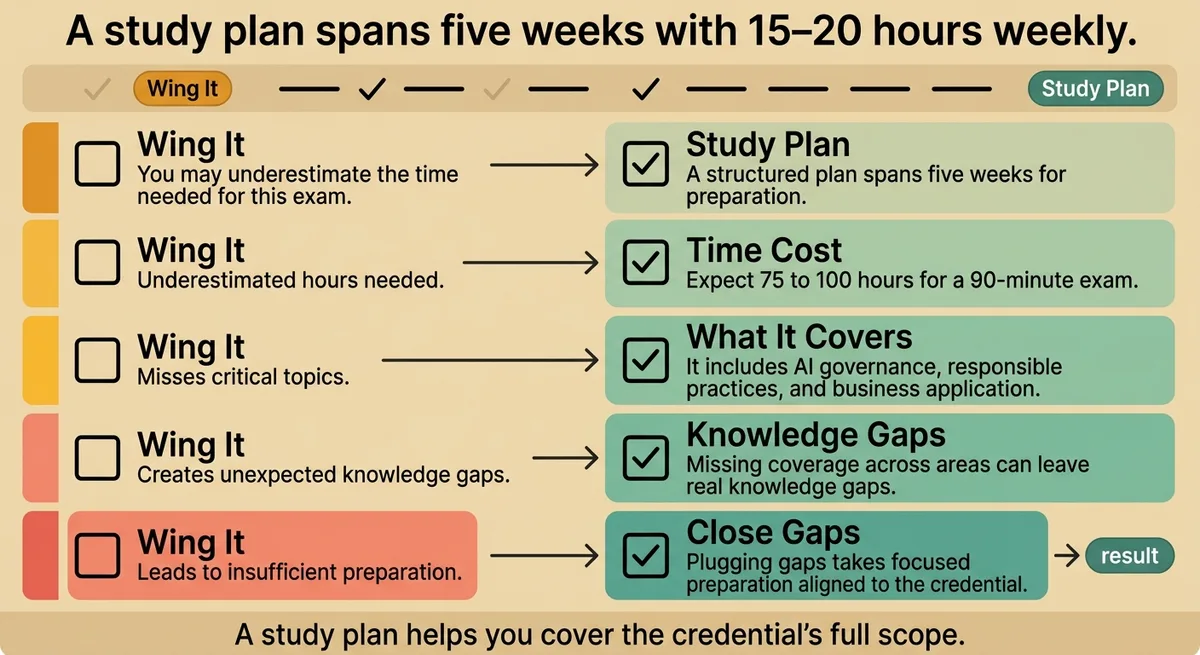
A structured study plan for this exam spans five weeks [\[3\]](#ref-3), with a suggested weekly commitment of 15 to 20 hours [\[3\]](#ref-3). That is 75 to 100 hours of preparation for a 90-minute exam [\[2\]](#ref-2).
That number surprises most people.
The credential covers AI governance, responsible AI practices, business application of generative AI, and strategic evaluation frameworks. If you do not work in a role that actively touches all four areas, you have real knowledge gaps. Plugging those gaps takes time. Assuming you can pass on general AI awareness is a $99 mistake you can avoid.
The exam allows up to nine retake attempts [\[3\]](#ref-3), with a mandatory 14-day waiting period between each attempt [\[3\]](#ref-3). That retake structure tells you something about the exam's difficulty curve. Google built in enough retake room that they expect a meaningful percentage of candidates to fail on the first attempt.
Failing once costs you $99 and two weeks. Failing twice costs $198 and a month. The cost of under-preparation is not abstract. It is a specific dollar amount and a specific delay.
Professionals with strong AI curiosity and weak structured knowledge who sit this exam without a study plan report feeling confident going in and confused during the exam. The fix is not more AI tool usage. The fix is a structured review of the four domain areas with weighted focus on the two heaviest topics.
Directional math on preparation time:
- 15 hours per week over 5 weeks is 75 total hours
- Spread across 4 domains weighted unevenly
- The top two domains should absorb roughly 65% of your study time
- That means 48 to 65 hours on two topic areas alone
Most people allocate zero hours to structured study. They review a few practice questions and sit the exam. The 14-day cooling period after a failed attempt is not a minor inconvenience. For a CEO preparing for a board presentation or a consultant pitching an AI strategy to a client, a two-week delay has real cost.
Google's sample questions can be taken an unlimited number of times [\[2\]](#ref-2), and they are untimed [\[2\]](#ref-2). Use that feature. The untimed format lets you build reasoning speed before you sit a timed exam. Rushing through them once is not practice. Repeating them until you can explain why each wrong answer is wrong is.
One more caveat: sample questions are available in one language [\[2\]](#ref-2). If you are preparing in a language other than the one used in the sample set, account for that gap in your preparation timeline.
* * *
How to Decide If This Credential Is Worth Pursuing Right Now
The credential stays valid for three years [\[2\]](#ref-2)[\[3\]](#ref-3). That validity window matters for how you think about timing.
If you pursue this credential and your role does not require you to communicate AI strategy, evaluate AI vendors, or advise on AI adoption, you will have a certificate and no immediate use for it. That is not a reason to skip it permanently. That is a reason to sequence it correctly.
The recommended timing based on study guidance is 8 to 10 weeks before you want to use the credential [\[3\]](#ref-3). Not 8 to 10 weeks before you sit the exam. Eight to ten weeks before the moment where the credential creates value for you: a job change, a client pitch, a board meeting, a promotion conversation.
Working backward from that moment is the right framework.
Ask three questions before you register:
1. Do I have a specific moment in the next 12 months where this credential changes how I am perceived or what I can deliver? 2. Can I commit 15 to 20 hours per week for five weeks to structured preparation? 3. Is my goal strategic AI literacy or technical AI capability?
If your answers are yes, yes, and strategic, register and build your study plan now.
If your goal is technical capability, this credential is not the right starting point. Look at Google Cloud's engineering-track certifications instead. They cover model deployment, prompt engineering at scale, and cloud-based AI infrastructure. This credential does not.
The $99 cost [\[2\]](#ref-2) is not a barrier for most professionals in this target audience. The real cost is 75 to 100 hours of focused preparation. For a CEO or operations leader with a full calendar, that time investment deserves a clear return. The return is a structured framework you can use internally, a verifiable credential you can show externally, and a three-year validity window that keeps the credential current through your next career phase.
One unexpected insight: the credential's non-technical positioning is a competitive differentiator right now. Most AI credentials in the market target engineers. Business leaders who hold a verifiable AI strategy credential are rare. That gap closes over time. The value of being an early holder is higher today than it will be in three years.
* * *
When a $99 Credential Signals More Than a Job Title Can
The Google Cloud Generative AI Leader certification does a specific job. It gives structured AI literacy to professionals who need to make decisions about AI, not build it. The four domain areas, the 90-minute format [\[2\]](#ref-2), the zero prerequisites [\[2\]](#ref-2), and the three-year validity [\[2\]](#ref-2) are all design choices that point to one audience: business leaders who are serious about AI strategy.
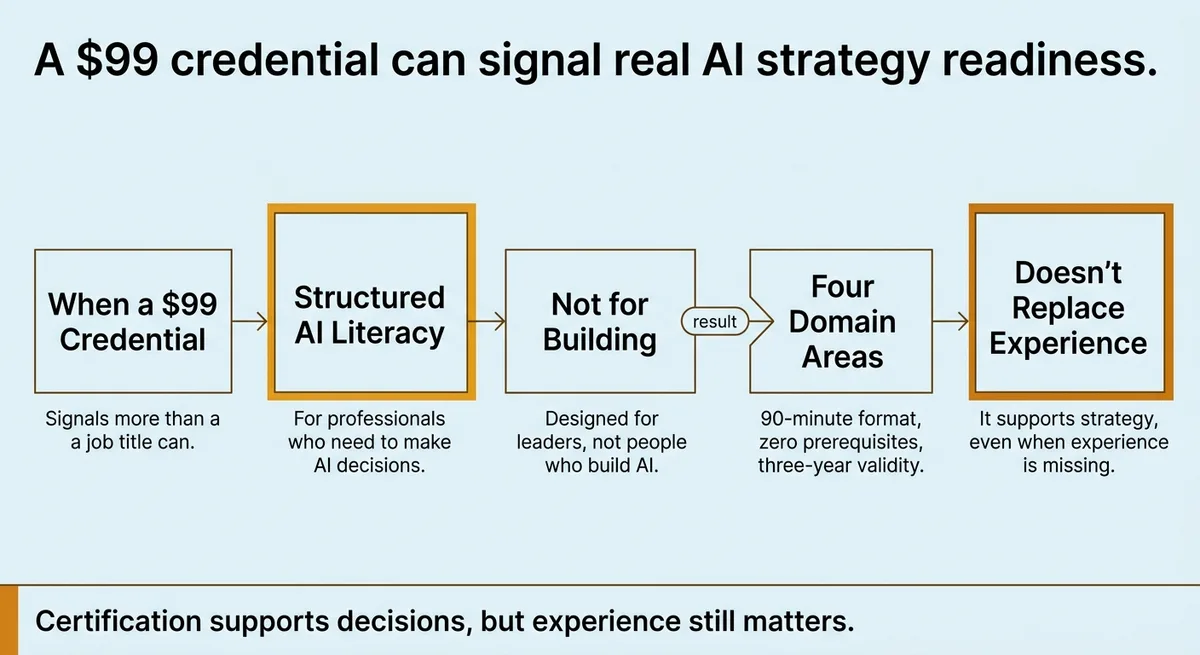
The credential does not replace experience. A CEO who holds this certification and has never run an AI initiative still has no track record. The Google Cloud Generative AI Leader certification provides a framework for building one, and a signal to others that you understand the space at a conceptual level.
If you have a board meeting, a client engagement, or a hiring decision in the next six months where AI fluency matters, the five-week study path [\[3\]](#ref-3) and the 8-to-10-week prep timeline [\[3\]](#ref-3) put you exactly where you need to be.
The preparation is real work. The exam is real assessment. The signal it sends is real credibility.
* * *
FAQ
Is Google Generative AI Leader certification worth it?
For business professionals who evaluate AI tools, communicate AI strategy, or advise organizations on AI adoption, the credential delivers a structured framework and a verifiable signal of literacy. The $99 cost [\[2\]](#ref-2) is not the barrier. The 75 to 100 hours of structured preparation is the real investment. If your role creates clear opportunities to use the credential in the next 12 months, it is worth pursuing.
What is generative AI leader certification?
The Google Cloud Generative AI Leader certification is a non-technical business credential. It tests your ability to apply generative AI concepts to strategic decisions, evaluate AI initiatives, and communicate AI risks and opportunities across teams. It covers four weighted topic domains [\[3\]](#ref-3), requires no prerequisites [\[2\]](#ref-2), and costs $99 [\[2\]](#ref-2).
How difficult is the Google Gen AI leader certification?
It is more difficult than most candidates expect based on their general AI familiarity. The exam tests structured business reasoning across four domains, not tool familiarity. The suggested study plan spans five weeks at 15 to 20 hours per week [\[3\]](#ref-3). The exam allows up to nine retake attempts [\[3\]](#ref-3), which signals that Google expects a meaningful failure rate on first attempts.
Is generative AI certification worth it?
A generative AI certification creates value when it maps to your role and your near-term professional goals. Non-technical credentials like this one are most valuable for business leaders, consultants, and operations managers who need to make AI decisions without building AI systems. The three-year validity period [\[2\]](#ref-2) gives you time to use the credential across multiple career moments.
What is a $900000 AI job?
This refers to senior AI leadership roles, including Chief AI Officer positions and AI strategy directors at large enterprises, that command total compensation above $900,000. These roles typically require demonstrated business results from AI initiatives, not just certifications. A credential like this one is a starting signal, not a path directly to that compensation level.
Is GenAI leader certification worth it?
For its target audience, yes. CEOs, operations managers, consultants, and digital transformation leaders who need a structured AI literacy framework and a credential to show for it will find the preparation valuable. Professionals who need hands-on technical skills should pursue engineering-track certifications instead. The decision comes down to whether your role requires AI strategy or AI engineering.
* * *
References and Citations
[\[1\]](#ref-1) [https://www.skills.google/paths/1951](https://www.skills.google/paths/1951)
[\[2\]](#ref-2) [https://cloud.google.com/learn/certification/generative-ai-leader](https://cloud.google.com/learn/certification/generative-ai-leader)
[\[3\]](#ref-3) [https://discuss.google.dev/t/why-google-clouds-generative-ai-leader-certification-is-your-next-career-move-and-how-you-can-ace-it-with-this-comprehensive-study-guide/269465](https://discuss.google.dev/t/why-google-clouds-generative-ai-leader-certification-is-your-next-career-move-and-how-you-can-ace-it-with-this-comprehensive-study-guide/269465)