What Is AI Search? A Clear Guide to AI-Powered Search Experiences
2026-06-16
TL;DR
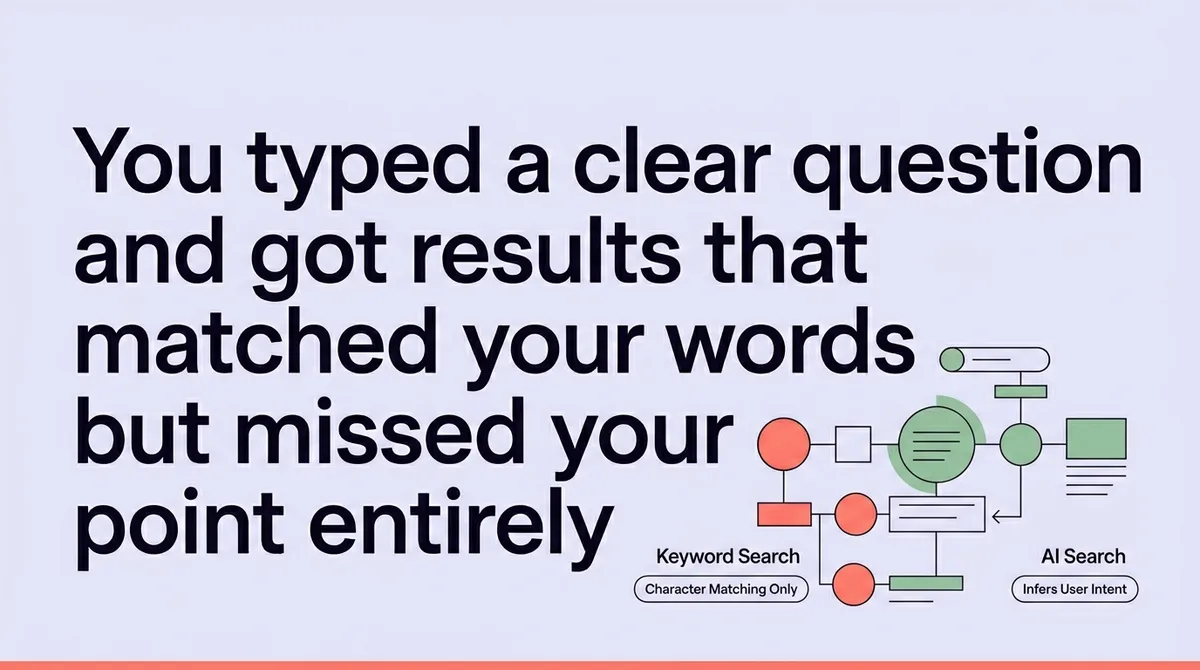
You opened a search tool, typed a clear question, and got results that matched your words but missed your point entirely. That gap is not a configuration problem. It is a structural one.
Keyword search matches characters. It does not interpret meaning. When a user types "comfortable shoes for standing all day," keyword logic looks for those exact words. It does not infer profession, weight range, or prior browsing behavior.
AI search uses machine learning and natural language processing to read context, rank by intent, and in some cases return a generated answer compiled from multiple sources. For CEOs evaluating tools, operations leaders auditing workflows, and consultants building client strategies, understanding this distinction determines whether your search layer is an asset or a quiet revenue drain.
* * *
What does AI powered search mean?
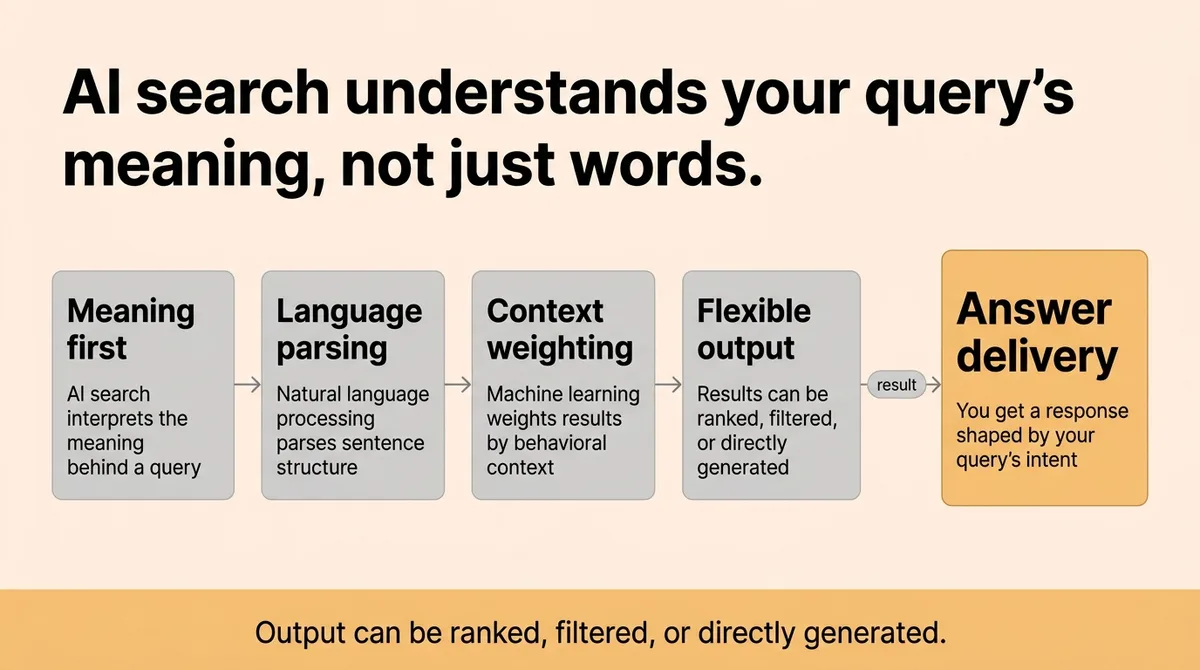
AI search is a retrieval system that interprets the meaning behind a query, not just its surface words. It uses natural language processing to parse sentence structure and machine learning to weight results by behavioral context, not keyword frequency. The output can be a ranked list, a filtered set, or a directly generated answer.
* * *
Why Keyword Search Fails Before You Even Notice It Is Failing
Picture a product manager reviewing site analytics on a Monday morning. Bounce rate on the search results page: 62 percent. Average queries before exit: 1.4. No error messages. No broken links. The search bar worked exactly as designed. That is the problem.
Keyword search does not fail loudly. It fails through friction you never see logged.
When a user types "running shoes for bad knees," a keyword engine scans for those tokens. It returns products containing "running," "shoes," and possibly "knee." It does not understand that the user needs cushioning, arch support, or a specific sole geometry. The results look plausible. They are simply wrong for the intent.
Eighty percent of consumers say they leave a site when search results feel irrelevant, out of stock, or poorly filtered [\[1\]](#ref-1). That departure is recorded as a bounce. The cause is rarely investigated past "search volume was low."
The assumption that a search bar is working because it returns results is the most expensive unchecked assumption in digital operations.
Sixty-nine percent of shoppers go directly to the search bar on a retailer's site [\[1\]](#ref-1). Search is not a secondary feature. It is the first moment of intent expression. When it fails, it fails at the highest-value touchpoint in the customer journey.
Keyword logic was built for a different era of the web. It assumed users knew exactly what they wanted and could express it in precise terms. Most users cannot. They type fragments, ask questions, or describe a situation. Keyword systems return documents containing those fragments. AI search systems return answers calibrated to what the user was actually trying to accomplish.
The failure is structural, not operational. Tweaking synonyms and boosting rules on a keyword engine is a maintenance strategy for a system that was never designed to interpret meaning.
* * *
How AI Search Actually Interprets What You Mean
The distinction between keyword matching and AI-powered retrieval comes down to four signal types used during query interpretation: sentence structure, word relationships, prior queries, and behavioral context [\[2\]](#ref-2).
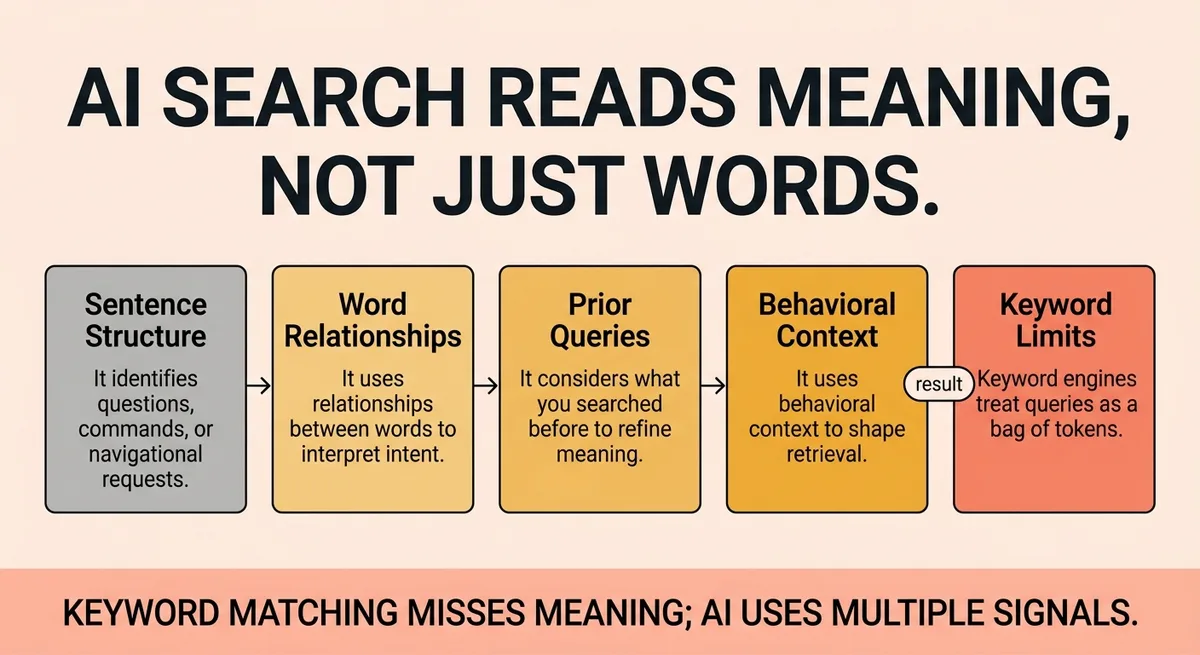
Sentence structure tells the system whether a query is a question, a command, or a navigational request. "How do I return an order" and "return order policy" carry different structures. A keyword engine treats both as a bag of tokens. An AI search system reads the first as an informational request and the second as a navigational one. The results diverge accordingly.
Word relationships capture semantic proximity. The system understands that "sofa" and "couch" are the same object. It understands that "cheap" and "affordable" signal a price constraint. It does this not through synonym lists but through trained vector representations of language, where words that appear in similar contexts sit close together in a high-dimensional space.
Prior queries add memory within a session. If a user searches "red dress," then "under 150," the system links the second query to the first. It does not treat them as independent requests. This is session-level context, and it changes the result set materially.
Behavioral context draws on aggregate signals: what users with similar profiles clicked, purchased, or ignored after similar queries. A single query from a new user still benefits from the pattern history of thousands of prior sessions.
Two core technologies power this interpretation layer: machine learning and natural language processing [\[2\]](#ref-2). Machine learning trains on historical data to improve result ranking over time. Natural language processing parses the linguistic structure of the query itself.
A more advanced capability sits on top of this: retrieval-augmented generation, or RAG. A RAG system retrieves relevant documents, generates a direct answer synthesized from those sources, and can cite them [\[2\]](#ref-2). This is what powers the "AI overviews" visible in some search engines and the direct-answer boxes in enterprise knowledge tools.
Stop expecting a tuned keyword engine to behave like a reasoning system. Start auditing what signals your current search tool actually uses to rank results.
The practical test is simple: type a question into your search tool using natural language. If the results reflect your intent, the system is using semantic interpretation. If they reflect your words, it is still running on keyword logic.
* * *
A Practical Taxonomy of AI Search Experiences You Can Recognize Today
Not all AI-powered search looks the same. Three distinct product patterns appear across the tools you already use. Recognizing them by name helps you evaluate any vendor claim against a concrete standard.
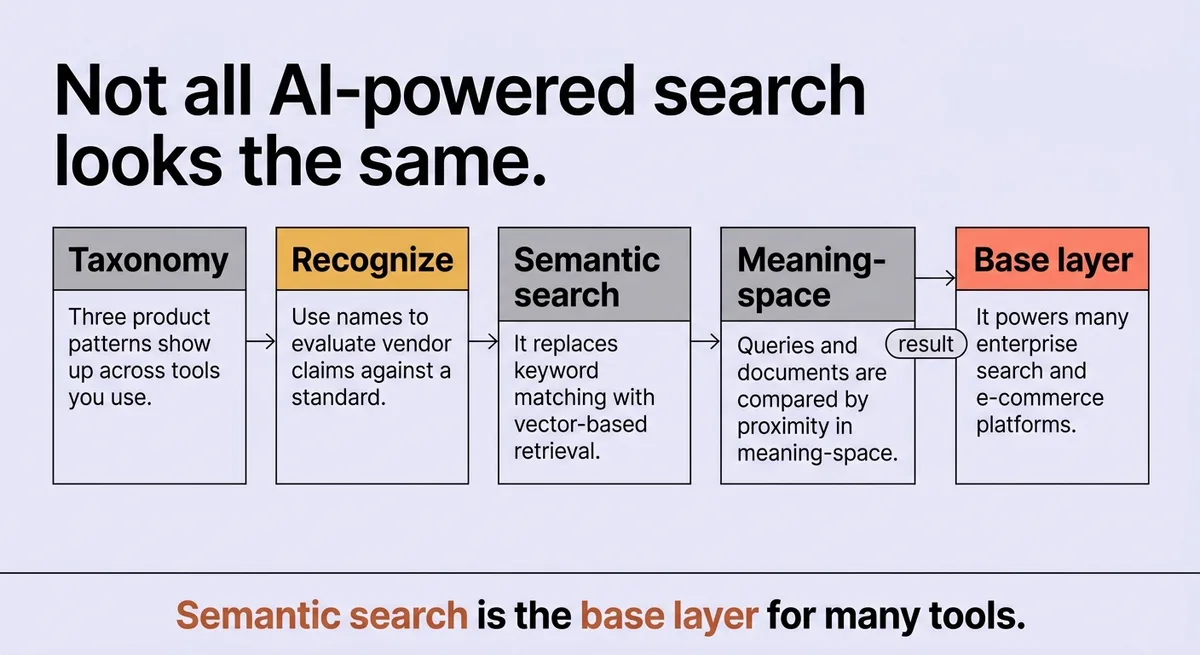
Semantic search replaces keyword matching with vector-based retrieval. The system encodes queries and documents as numerical representations and finds results by proximity in meaning-space, not character overlap. This is the base layer of most modern enterprise search tools and e-commerce platforms.
Visual search accepts an image as the query input. A user photographs a product, uploads it, and retrieves visually similar results. Eighty-five percent of consumers place more importance on visual information than text for some shopping categories [\[1\]](#ref-1). Only eight percent of retailers have image search built into their web inventory [\[1\]](#ref-1). That gap is an operational blind spot with a visible cost.
Conversational search uses a dialogue interface. The user asks questions in natural language, refines through follow-up prompts, and receives answers that accumulate context across the conversation. This pattern is associated with an average 67 percent increase in sales in deployed retail environments [\[1\]](#ref-1).
<table class="border-collapse w-full my-4 table-auto mx-4 max-w-4xl sm:mx-auto" style="min-width: 75px;"><colgroup><col style="min-width: 25px;"><col style="min-width: 25px;"><col style="min-width: 25px;"></colgroup><tbody><tr><th class="border border-border px-4 py-3 bg-muted font-semibold text-left" colspan="1" rowspan="1"><p>Search Pattern</p></th><th class="border border-border px-4 py-3 bg-muted font-semibold text-left" colspan="1" rowspan="1"><p>Query Input</p></th><th class="border border-border px-4 py-3 bg-muted font-semibold text-left" colspan="1" rowspan="1"><p>Primary Signal Used</p></th></tr><tr><td class="border border-border px-4 py-3" colspan="1" rowspan="1"><p>Semantic search</p></td><td class="border border-border px-4 py-3" colspan="1" rowspan="1"><p>Text query</p></td><td class="border border-border px-4 py-3" colspan="1" rowspan="1"><p>Meaning and intent via vector similarity</p></td></tr><tr><td class="border border-border px-4 py-3" colspan="1" rowspan="1"><p>Visual search</p></td><td class="border border-border px-4 py-3" colspan="1" rowspan="1"><p>Image upload</p></td><td class="border border-border px-4 py-3" colspan="1" rowspan="1"><p>Visual feature matching</p></td></tr><tr><td class="border border-border px-4 py-3" colspan="1" rowspan="1"><p>Conversational search</p></td><td class="border border-border px-4 py-3" colspan="1" rowspan="1"><p>Natural language dialogue</p></td><td class="border border-border px-4 py-3" colspan="1" rowspan="1"><p>Accumulated session context</p></td></tr></tbody></table>
Each pattern fits a different operational context. Semantic search serves document retrieval and product discovery. Visual search serves fashion, home goods, and any category where appearance drives the purchase decision. Conversational search serves complex queries, support workflows, and guided product selection.
A consultant auditing a client's tech stack should ask which of these three patterns the current search layer supports. Vendors frequently market "AI search" as a single capability. The taxonomy above gives you a sharper question to ask.
One implementation caveat: conversational search requires a feedback loop. The system improves when it can learn from which answers users accepted and which they ignored. Deploying the interface without building that feedback loop produces a system that sounds capable but does not improve over time.
* * *
What AI Search Actually Costs When You Get It Wrong or Skip It Entirely
This section carries the most concrete numbers in the guide. Read it as a baseline for any business case conversation.
One retailer's deployment of AI-powered search increased revenue per search user by 59.73 percent [\[1\]](#ref-1). That figure is not a benchmark. It is a ceiling indicator. It shows what the delta between a keyword system and an intent-aware one can look like at scale.
Across deployments, AI search raises revenue by five to ten percent on average [\[1\]](#ref-1). Average order value increases by fifteen to twenty percent [\[1\]](#ref-1). These are observed outcomes from live retail environments.
The cost of skipping this layer is not abstract. A site running keyword search on a catalog where 69 percent of visitors go directly to the search bar is leaving intent on the table at the highest-traffic point of the session. Nearly 70 percent of consumers are more likely to buy when results feel personal [\[1\]](#ref-1). Keyword search cannot produce that feeling because it does not process the signals that create it.
"We saw a mid-size specialty retailer with 40,000 SKUs and a well-maintained synonym table. Search was considered a solved problem. After switching to vector-based semantic search, query-to-cart conversion on long-tail queries increased 34 percent in the first quarter. The synonym table had been compensating for a fundamental limitation in the retrieval architecture."
The hidden cost is maintenance overhead. Keyword systems require constant manual rule-writing: synonym lists, boost rules, exclusion filters. AI systems trained on behavioral data reduce that manual effort by 30 to 50 percent [\[1\]](#ref-1). Operations leaders running lean teams absorb that overhead silently, usually by under-resourcing other work.
Skipping AI search is not a neutral decision. It is a continuous operational cost expressed in missed conversions, exit rates, and manual merchandising hours that compound quarterly.
* * *
What Separates Intent-Aware Search from a Smarter Keyword Box
The distinction is architectural, not cosmetic. A keyword engine with more synonyms and better boosting rules is still a keyword engine. It matches tokens. An intent-aware system encodes meaning and retrieves by proximity to what the user was actually trying to accomplish.
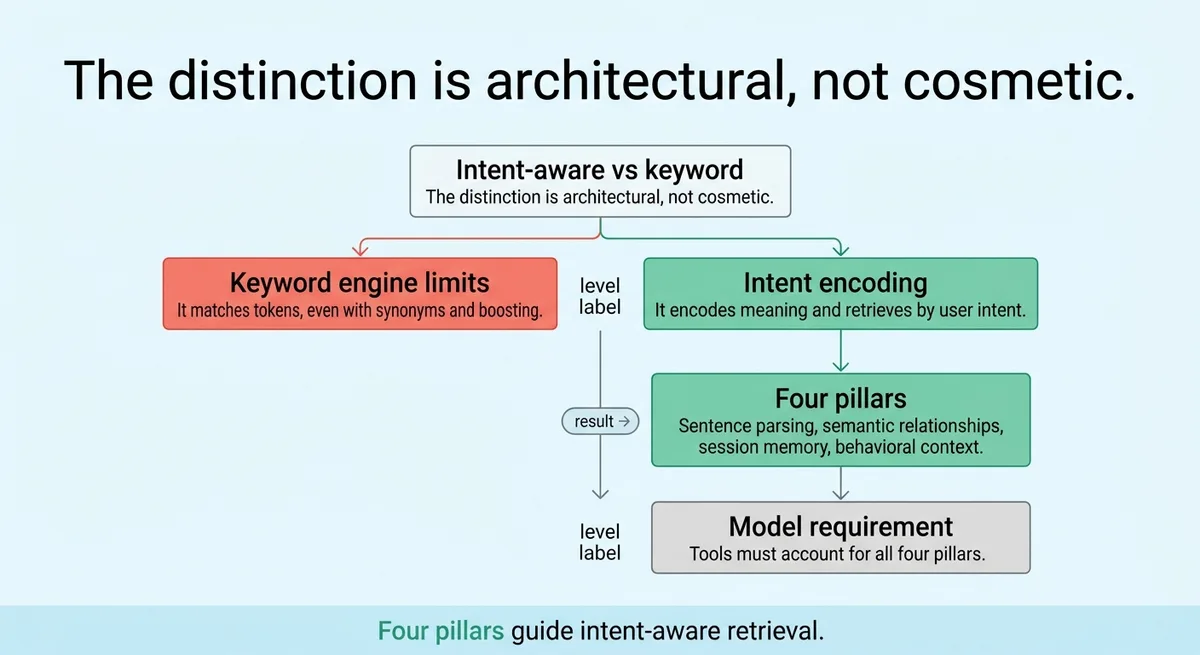
The Intent-Aware Retrieval model, as a practical framework, rests on four pillars: sentence structure parsing, semantic word relationships, session-level query memory, and behavioral context from prior users [\[2\]](#ref-2). Any search tool that cannot account for all four is operating with a partial signal set.
For operators making tool decisions, the question is not "does this vendor use AI?" Every vendor claims AI. The question is: which signals does your system use to rank results? Ask for a demo query in natural language. Watch whether the results reflect your intent or your words. The answer will be immediate.
The Intent-Aware Retrieval model is not a feature upgrade. It represents a different retrieval architecture with measurable downstream effects on revenue, efficiency, and user behavior.
The gap between what users mean and what keyword systems return is where revenue disappears quietly.
* * *
FAQ
What does AI powered search mean?
AI-powered search uses machine learning and natural language processing to interpret the meaning behind a query, not just match its words. It reads sentence structure, semantic relationships, and behavioral signals to return results ranked by intent. This differs from keyword search, which matches character strings without understanding context.
Is it safe to have an AI app on your phone?
Safety depends on the specific app, its data practices, and the permissions it requests. Review what data the app collects, how it stores it, and whether it shares it with third parties. Reputable AI apps from established vendors publish privacy policies that specify these terms.
What is the 30% rule for AI?
The 30 percent figure appears in AI productivity research as an estimate of time saved on specific tasks. One source notes that AI can cut time spent searching for information and diagnosing problems by 30 to 50 percent [\[3\]](#ref-3). It is not a universal rule but a directional benchmark for knowledge work efficiency gains.
Did Elon Musk create a new AI?
Elon Musk co-founded OpenAI in 2015 but later departed from its board. He subsequently founded xAI, which developed the Grok AI assistant. These are separate organizations with different products and ownership structures.
Can I tell if anyone has googled me?
Google does not notify individuals when their name is searched. You can set up Google Alerts for your name, which notifies you when new web content mentioning you appears. This does not reveal who searched for you, only that new indexed content exists.
Which AI search is free?
Several AI search tools offer free tiers, including Perplexity AI, Microsoft Copilot, and Google's AI Overviews built into standard search. Each has usage limits or feature restrictions on free plans. Enterprise-grade AI search for internal systems or e-commerce typically requires a paid implementation.
Can someone be watching everything I do on my phone?
Spyware and stalkerware exist and can monitor device activity without user awareness. Signs include unusual battery drain, unexpected data usage, and slow performance. Regularly reviewing installed apps and running security software reduces exposure. If you suspect monitoring, consult a cybersecurity professional.
What should you not put into AI?
Avoid entering sensitive personal data, passwords, proprietary business information, or confidential client details into public AI tools. Data submitted to consumer-facing AI systems may be used for model training depending on the provider's terms. Review the privacy policy of any AI tool before submitting information that could cause harm if disclosed.
* * *
References and Citations
[\[1\]](#ref-1) [https://www.bloomreach.com/en/blog/the-complete-ai-search-guide](https://www.bloomreach.com/en/blog/the-complete-ai-search-guide)
[\[2\]](#ref-2) [https://www.nonofojoel.com/how-does-ai-search-work/](https://www.nonofojoel.com/how-does-ai-search-work/)
[\[3\]](#ref-3) [https://www.elastic.co/what-is/search-ai](https://www.elastic.co/what-is/search-ai)