The First llms.txt Checklist for Businesses That Want Better AI Representation
2026-06-21
TL;DR
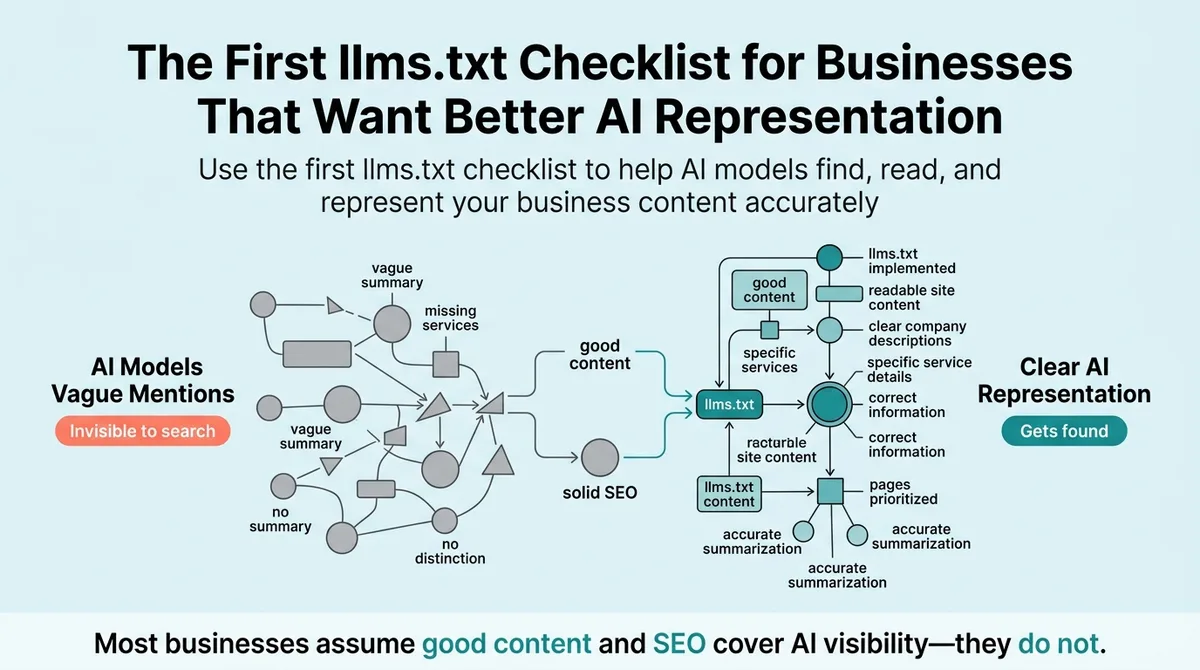
You open a ChatGPT response about your industry and find a competitor described clearly, specifically, and correctly. Your business either gets a vague mention or nothing. That gap is not about brand awareness. It is about how AI models read your site.
Most businesses assume that good content and solid SEO cover their AI visibility. Those tools handle search engines. They do not tell AI models what your company does, which pages matter, or how to summarize your services accurately.
An llms.txt file fixes this directly. It sits at your domain root, uses structured Markdown, and gives AI systems a single readable document that describes your business on your terms. This checklist shows CEOs, operations leads, and founders exactly how to build it, layer by layer, before competitors claim that ground first.
* * *
What llms.txt Actually Is and Why Confusing It With robots.txt Will Cost You
Stop treating these two files as variations of the same idea. They solve entirely different problems for entirely different readers.
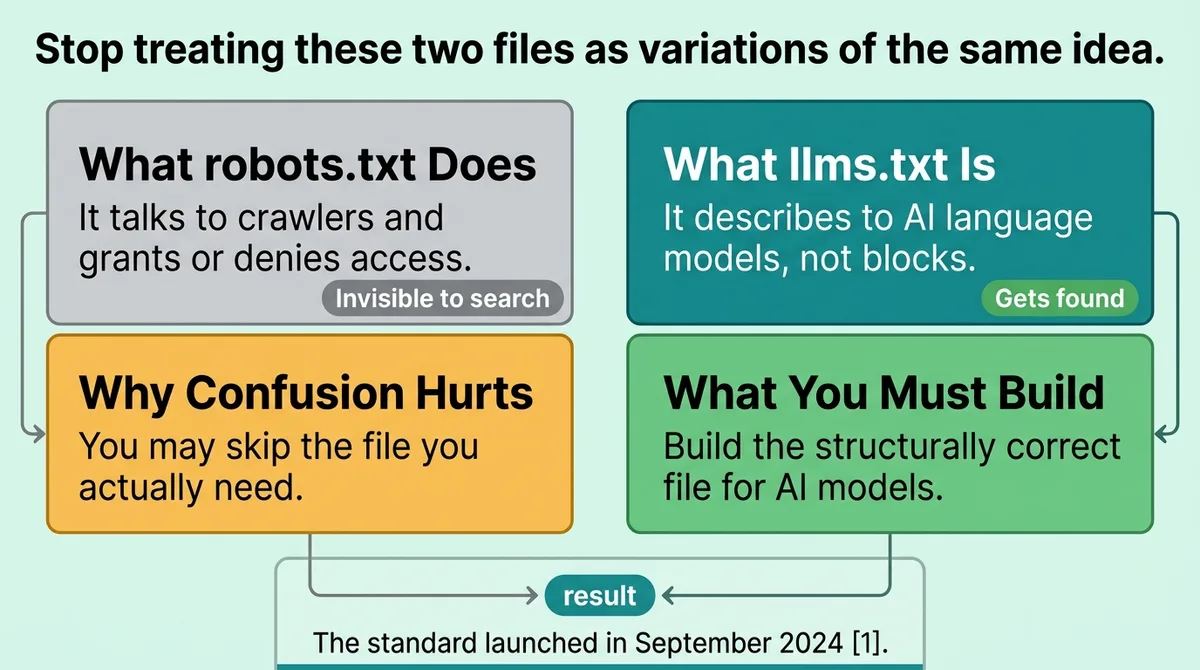
A robots.txt file talks to crawlers. It grants or denies access to specific paths. An llms.txt file talks to AI language models. It does not block anything. It describes. The moment you mix up those functions, you either skip building the file you actually need or you build something structurally wrong.
The standard launched in September 2024 [\[1\]](#ref-1). Google's stated position on it remained unchanged as of July 2025 [\[1\]](#ref-1). That gap matters. This file was not created to satisfy a search engine requirement. It was created to give AI models a reliable, structured source of business context that standard HTML pages do not cleanly provide.
Here is the practical difference in a single table:
<table class="border-collapse w-full my-4 table-auto mx-4 max-w-4xl sm:mx-auto" style="min-width: 75px;"><colgroup><col style="min-width: 25px;"><col style="min-width: 25px;"><col style="min-width: 25px;"></colgroup><tbody><tr><th class="border border-border px-4 py-3 bg-muted font-semibold text-left" colspan="1" rowspan="1"><p>File</p></th><th class="border border-border px-4 py-3 bg-muted font-semibold text-left" colspan="1" rowspan="1"><p>Audience</p></th><th class="border border-border px-4 py-3 bg-muted font-semibold text-left" colspan="1" rowspan="1"><p>Function</p></th></tr><tr><td class="border border-border px-4 py-3" colspan="1" rowspan="1"><p>robots.txt</p></td><td class="border border-border px-4 py-3" colspan="1" rowspan="1"><p>Search crawlers</p></td><td class="border border-border px-4 py-3" colspan="1" rowspan="1"><p>Access control for page paths</p></td></tr><tr><td class="border border-border px-4 py-3" colspan="1" rowspan="1"><p>llms.txt</p></td><td class="border border-border px-4 py-3" colspan="1" rowspan="1"><p>AI language models</p></td><td class="border border-border px-4 py-3" colspan="1" rowspan="1"><p>Context and content prioritization</p></td></tr><tr><td class="border border-border px-4 py-3" colspan="1" rowspan="1"><p>llms-full.txt</p></td><td class="border border-border px-4 py-3" colspan="1" rowspan="1"><p>AI language models</p></td><td class="border border-border px-4 py-3" colspan="1" rowspan="1"><p>Complete site content in one pass</p></td></tr></tbody></table>
The "friend advice" version of this: Stop writing your llms.txt like a gatekeeper file. Start writing it like a briefing document you hand to someone before they describe your business to a room full of buyers.
A robots.txt error locks a bot out. An llms.txt error gives a model the wrong story about you. Those are not equivalent consequences. One is a crawl gap. The other is a representation gap that plays out every time someone asks an AI about your industry.
* * *
The Hidden Problem: AI Models Are Already Summarizing Your Site Without Your Input
AI models do not wait for your permission before forming an opinion about your business. They have already read your site, drawn inferences from your copy, and built a working summary. That summary is what gets surfaced when someone asks about your category, your services, or your competitors.
Over 500 million AI bot traffic events were analyzed across a broad content sample [\[1\]](#ref-1). Within a 90-day window, only 408 requests targeted an llms.txt file directly [\[1\]](#ref-1). That number tells you two things at once. AI systems are actively processing sites at massive scale. Almost none of those sites have given the model anything structured to work from.
The sting: your site's AI summary is already written. You just did not write it.
When a model reads your homepage, your about page, and three blog posts, it builds its own summary from whatever signals dominate those pages. If your homepage leads with vague positioning, the model reflects that vagueness. If your services page buries your most important offering under three paragraphs of context, the model may not surface it at all.
This is the actual cost. A prospect asks an AI assistant which vendors offer your specific service in your region. The model answers using what it learned from the pages it processed. Your competitor added a clear, structured llms.txt file. You did not. The model describes them with precision. Your mention is fuzzy or absent.
That is not a traffic loss. That is a sales conversation that never starts.
* * *
The Four-Layer Framework: How to Build Your llms.txt File Section by Section
The Four-Layer Framework is a build-order approach. Each layer adds a specific type of context. You do not need technical expertise to execute it. You need a text editor, your domain root access, and thirty minutes.
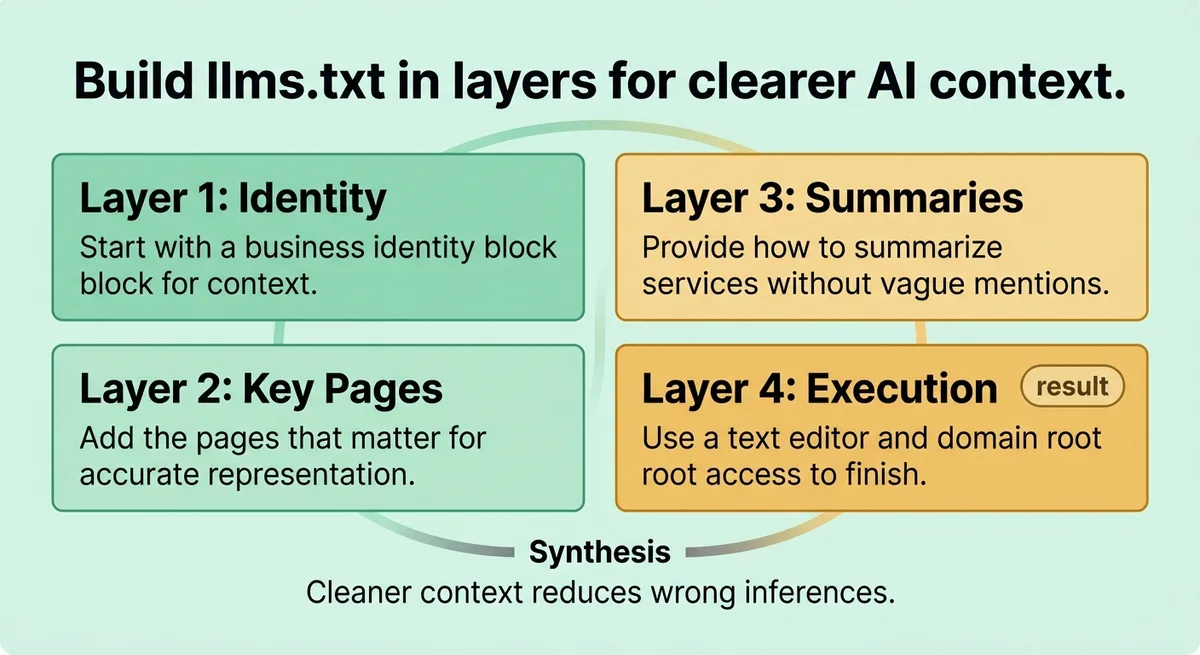
One Markdown-based approach to structuring this file can reduce token load by up to 10x compared to standard HTML pages [\[1\]](#ref-1). That reduction matters because AI models process cleaner, denser content more accurately. Less noise means fewer wrong inferences.
Layer 1: Business Identity Block
Open with one to three sentences that describe what your business does, who it serves, and what makes your positioning distinct. Write it the way you would brief a new analyst before a client call. Avoid jargon. Avoid slogans.
``` # Acme Operations Group > B2B workflow automation consulting for manufacturers with 50–300 employees. > We build integration layers between ERP systems and shop-floor operations software. ```
Layer 2: Priority URL List
List the five to ten pages that carry the most accurate and important information about your business. Use Markdown links with brief descriptive labels. This tells the model which pages to weight when it forms a summary.
``` ## Key Pages - [Services Overview](https://yourdomain.com/services) - [Case Studies](https://yourdomain.com/results) - [About the Team](https://yourdomain.com/about) ```
Layer 3: Content Category Signals
Group your content by topic area. This helps AI systems understand your domain scope without reading every page. Label each category clearly. Three to six categories work well for most SMBs.
``` ## Content Areas - Workflow Automation: guides, templates, and implementation walkthroughs - ERP Integration: connector documentation and vendor comparisons - Operations Advisory: frameworks and diagnostic tools ```
Layer 4: Representation Guidance
This layer is optional but high-value. Write two to four sentences that tell the model how your business should not be described. Correct common misclassifications. Name adjacent categories you do not belong to.
``` ## About Our Work We are not a software vendor. We do not sell licenses. We consult and implement. All client engagements are custom-scoped. ```
Four structural rules apply across every layer [\[1\]](#ref-1): use clean Markdown headers, keep sections short and labeled, avoid prose-heavy paragraphs inside the file, and link only to pages that are publicly accessible and fully indexed.
A case example: one operations consulting firm rewrote their llms.txt after realizing an AI assistant kept categorizing them as an IT staffing company. They added a four-sentence Representation Guidance block. Within six weeks, unprompted AI-generated descriptions of their firm shifted to consulting and implementation language. No other pages changed.
We saw the wrong category persist. We added the guidance block. The model's descriptions corrected.
* * *
The Adoption Gap Most Businesses Are Missing Right Now
A study covering 300,000 domains measured actual llms.txt adoption [\[1\]](#ref-1). The adoption rate was 10.13% [\[1\]](#ref-1). Read that twice.
Roughly nine out of ten businesses have not built this file yet. That reflects how recently the standard launched and how little distribution most operational guidance on this topic has received. For CEOs and operations leads reading this now, the gap is the opportunity.
Early adoption here is not about chasing trends. It is about claiming the structuring work before it becomes table stakes. Search engine optimization took years to become normalized. The window to move before everyone else is short.
Here is a readiness benchmark to place yourself against:
<table class="border-collapse w-full my-4 table-auto mx-4 max-w-4xl sm:mx-auto" style="min-width: 100px;"><colgroup><col style="min-width: 25px;"><col style="min-width: 25px;"><col style="min-width: 25px;"><col style="min-width: 25px;"></colgroup><tbody><tr><th class="border border-border px-4 py-3 bg-muted font-semibold text-left" colspan="1" rowspan="1"><p>Readiness Signal</p></th><th class="border border-border px-4 py-3 bg-muted font-semibold text-left" colspan="1" rowspan="1"><p>Not Ready</p></th><th class="border border-border px-4 py-3 bg-muted font-semibold text-left" colspan="1" rowspan="1"><p>Partially Ready</p></th><th class="border border-border px-4 py-3 bg-muted font-semibold text-left" colspan="1" rowspan="1"><p>Ready</p></th></tr><tr><td class="border border-border px-4 py-3" colspan="1" rowspan="1"><p>Business description centralized</p></td><td class="border border-border px-4 py-3" colspan="1" rowspan="1"><p>Scattered across pages</p></td><td class="border border-border px-4 py-3" colspan="1" rowspan="1"><p>Exists but buried</p></td><td class="border border-border px-4 py-3" colspan="1" rowspan="1"><p>Clear, one-paragraph summary</p></td></tr><tr><td class="border border-border px-4 py-3" colspan="1" rowspan="1"><p>Priority pages identified</p></td><td class="border border-border px-4 py-3" colspan="1" rowspan="1"><p>Unknown</p></td><td class="border border-border px-4 py-3" colspan="1" rowspan="1"><p>Loosely defined</p></td><td class="border border-border px-4 py-3" colspan="1" rowspan="1"><p>Named list of 5–10 URLs</p></td></tr><tr><td class="border border-border px-4 py-3" colspan="1" rowspan="1"><p>Content categories labeled</p></td><td class="border border-border px-4 py-3" colspan="1" rowspan="1"><p>Not organized</p></td><td class="border border-border px-4 py-3" colspan="1" rowspan="1"><p>Informal groupings</p></td><td class="border border-border px-4 py-3" colspan="1" rowspan="1"><p>Defined and documented</p></td></tr><tr><td class="border border-border px-4 py-3" colspan="1" rowspan="1"><p>llms.txt file deployed</p></td><td class="border border-border px-4 py-3" colspan="1" rowspan="1"><p>None</p></td><td class="border border-border px-4 py-3" colspan="1" rowspan="1"><p>Draft exists</p></td><td class="border border-border px-4 py-3" colspan="1" rowspan="1"><p>Live at domain root</p></td></tr></tbody></table>
If you sit in the "Not Ready" column across most rows, the Four-Layer Framework gives you a path forward in a single working session.
The businesses most likely to benefit first are those with complex or easily miscategorized services. If your offering sits at the intersection of two categories or serves a niche market, AI models are the most likely to get your description wrong without structured guidance. A file that takes thirty minutes to build can correct that misrepresentation across every AI-powered channel where your business might appear.
Waiting is not a neutral position. Every week without this file is another week of AI-generated summaries built from incomplete signals. The adoption gap is closing. The question is whether you close it on your terms or inherit whatever description the model assembled on its own.
* * *
Build It Once and Let AI Models Finally Get You Right
The Four-Layer Framework is not a complex system. It is a structured briefing document written in plain Markdown, placed where AI models can find it, and maintained as your business evolves.
Business Identity. Priority URLs. Content Category Signals. Representation Guidance. Four layers. One file. No special tooling required.
The businesses that move now are not doing more work than those who wait. They are doing thirty minutes of specific work before that work becomes a standard line item on every competitor's launch checklist.
Your llms.txt file is not live yet. That means every AI-generated description of your business right now is a guess. Write the file. Place it at your domain root. Let the model use your words.
* * *
References and Citations
[\[1\]](#ref-1) [https://limy.ai/blog/llms.txt-in-2026-the-full-guide](https://limy.ai/blog/llms.txt-in-2026-the-full-guide)